Switching Memory Infrastructure

Most teams don’t even consider switching memory infrastructure.
And it’s not because of cost. It’s not because of performance. It’s psychology.
We often see companies sticking with a tool that’s “fine” even when something better exists. The better tool isn’t competing with the old tool, it’s competing with everything it took to adopt the old one.
In AI memory, that effect is even stronger.
Because memory infrastructure feels like the kind of thing you integrate once, and never touch again.
The real reason teams don’t switch memory
- You picked the first memory tool that worked
- Engineering invested time in making it production-ready
- It works decently
- It isn’t catastrophically broken
- So switching doesn’t feel urgent
And when the pain isn’t urgent, rational decision-making gets replaced with inertia.
Which brings us to the two blockers:
Supermemory feels “too simple” to be real
“It’s one line of code… how could this be more powerful than my 1000-line memory.py file?”
Most engineering teams are used to memory integration being complicated:
- retrieval logic
- chunking policies
- embedding pipelines
- query routing
- retries
- edge cases
- evaluation
- prompt stuffing
And when you’ve experienced that pain, “one line of code” doesn’t sound like a serious system. It sounds like marketing.
But here’s the truth:
Supermemory is stupidly easy to integrate on purpose. Not because it’s doing less. Because it’s doing more of the hard work under the hood.
Supermemory lets you manage context at any “layer” of your stack without forcing you to build and maintain a memory system from scratch.
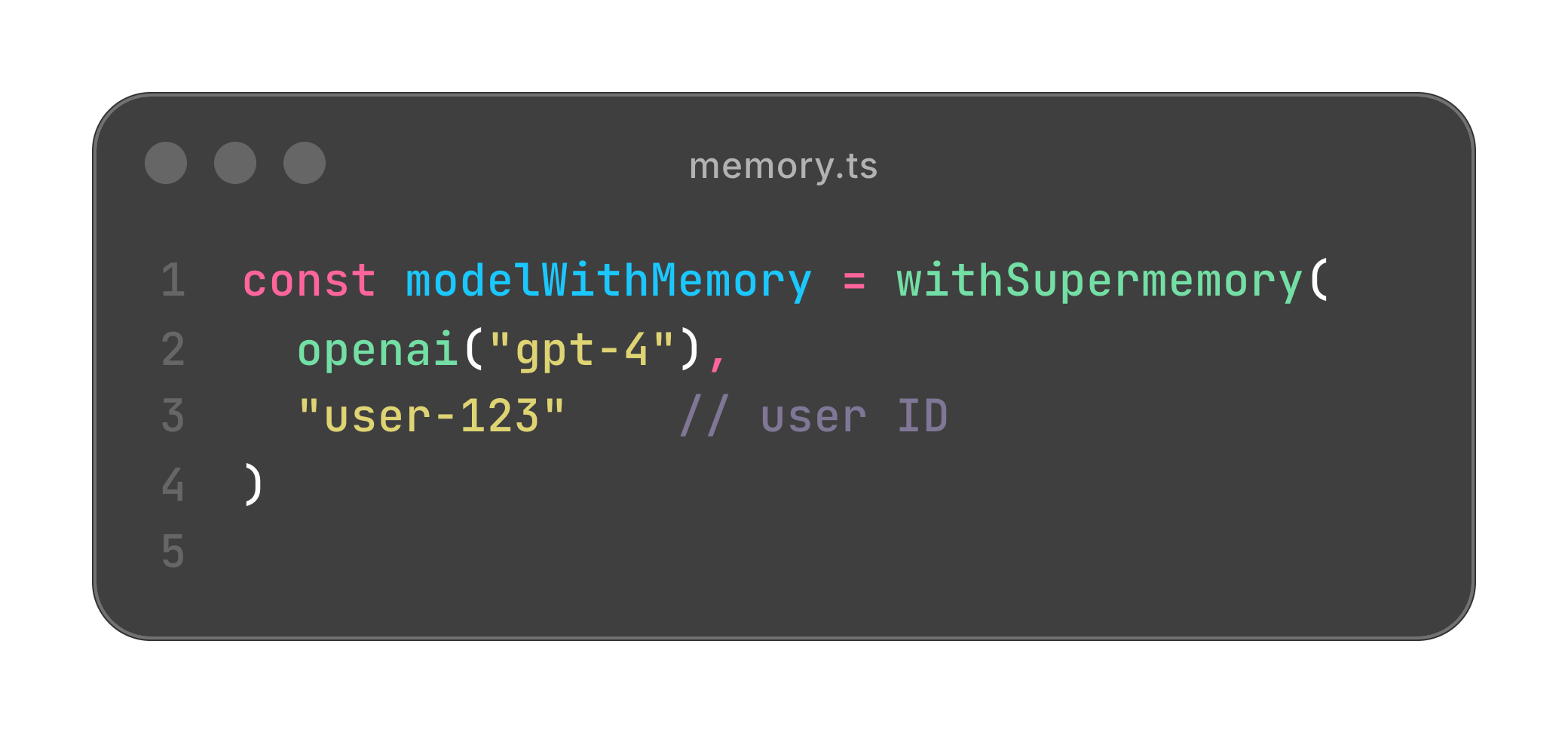
That one line of code isn’t “simple.” It’s just clean.
And in infra, less code is often more power.
Sunk cost fallacy
A lot of teams picked the first memory tool that worked. Not because it was best, but because it was available and it shipped early; and because it shipped early, it became the default choice.
Engineering teams then did what engineering teams always do:
they made it work in production.
They wrote wrappers, pipelines, abstractions. They debugged edge cases. They built around it. They invested effort until it became part of the infrastructure.
At that point, switching doesn’t feel like a tool choice.
It feels like undoing months of work.
So even when a better memory product exists, the decision doesn’t become:
“Is this better?”
It becomes:
“Is this better enough to justify switching?”
That gap is what keeps “good enough” tools in place forever, even when they aren’t actually the best option.
And this is exactly what sunk cost fallacy looks like in engineering decision-making:
- the cost is already paid
- the system works
- switching feels irrational
- so the decision gets delayed indefinitely
Switching memory doesn’t have to be dramatic
The biggest misconception about switching memory infrastructure is that it has to be a migration project. It doesn’t.
You don’t need to rewrite anything. You don’t need to rebuild your stack. You don’t need to rip out your existing system overnight.
You can start small:
- one workflow
- one agent
- one environment
- one feature behind a flag
And then scale only after you see results.
What you’ll notice immediately when you switch to Supermemory
If you integrate Supermemory the right way, the difference is obvious quickly:
- Better relevance
Memory should bring the right context at the right time, not random nearby chunks. - Better latency
Memory infra should be fast enough to disappear into the experience. - Better context retention
You shouldn’t have to re-explain the same things across workflows, calls, and tasks. - Lower token cost
A lot of memory systems “work” by stuffing prompts which increases cost, latency, instability, and failure rate.
How are we more cost efficient? Read more!
More capability, not just better retrieval
Supermemory isn’t just “retrieval.”
It ships primitives that teams actually need for real memory systems like:
- user profiles
- connectors
- structured context management
The easiest way to decide: don’t argue; just benchmark
We don’t ask you to take our word for it.
Try Supermemory.
Run the demo, integrate it in a small flow, compare it against your current solution.
Or even better - benchmark your existing memory system against Supermemory using memorybench.
You’ll know what’s best for you.